
Nobody moves a box for nothing. Free shipping is a pricing choice rather than a gift, and the cost lands somewhere: in the product price, in a minimum order value, or in the seller’s margin. Spotting which one you’re looking at makes you a sharper shopper and a steadier merchant.
So what does it mean at checkout? The store covers the carrier’s charge instead of billing you for it. Most retailers attach a condition, such as a minimum order value, a paid membership, or a promotion window. The delivery cost still exists. It moves from your card to the seller’s operating budget.
Delivery at no charge, at a glance
| Question | Short answer |
|---|---|
| What it means | The seller pays the carrier, so no delivery line appears on your bill |
| Who pays in practice | You do, through product pricing, a bigger cart, or a membership fee |
| Typical US minimum | Roughly $35 to $75, usually set above the store’s average order value |
| Common conditions | Eligible items only, contiguous US addresses, standard speed |
| What it costs a seller | Parcel rate, packaging, handling, plus the return trip on anything sent back |
| Smartest shopper move | Compare the top-up amount against the fee before adding a filler item |
TL;DR
- Nothing travels for nothing. Cost sits in the price, the threshold, or the margin.
- Most US stores put their minimum 20% to 50% above their average order value.
- Absorb a $9 parcel on a 40% gross margin, and you need about $23 more revenue per order.
- Shoppers: add a filler item only when you’d have bought it anyway.
- Sellers: run the arithmetic on your own dollar figures before copying a rival’s threshold.
What “free” delivery really means at checkout
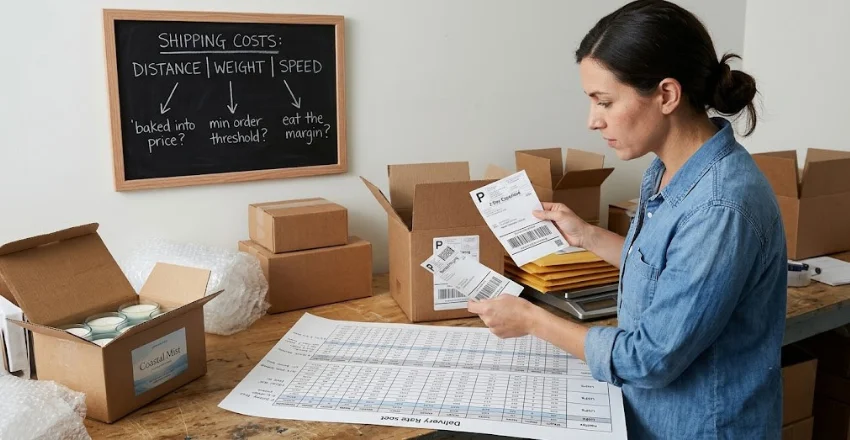
Retailers don’t get free postage. They pay a carrier per parcel, and that rate moves with weight, box size, distance, and speed. A label to the next county costs a fraction of one crossing three time zones.
Every offer you see is funded by one of three routes.
- Higher product prices. The carrier’s fee gets baked into the sticker price and spread across every buyer, including the ones who live nearby.
- A minimum order value. You reach a threshold, and the extra gross margin on the bigger cart pays for the box.
- A thinner margin. Sellers eat the cost to win the sale, betting on repeat orders later.
Which route a seller picks depends on the catalog. A store selling $14 candles can’t swallow a $9 parcel on a single-item order without going backwards. A store selling $300 jackets barely notices it.
Why stores set a minimum order value
The minimum does two jobs at once. It screens out tiny orders that lose money on every label, and it nudges you toward one more item. Plenty of shoppers take that nudge, which is exactly the point.
That nudge pays. Lifting the average cart by a few dollars across thousands of orders covers the freight bill and then some. Cart abandonment drops too, because a delivery fee that appears at the final step is one of the oldest reasons people walk away from a checkout. Shoppers hate surprises more than they hate costs.
How to get delivery at no charge without overspending
This is arithmetic, not luck. Before topping up the cart, run the filler item test: would you buy that add-on next month anyway? If yes, adding it beats paying the fee. If no, you’re spending $12 to save $7, and the store wins. Where the top-up fails that test, buying in person can be cheaper, and our comparison of buying online instead of in store weighs both routes.
- Check the threshold before you shop, then build the cart to it once.
- Look for a store account or loyalty tier that waives the charge, since a membership often beats a per-order fee.
- Don’t split an order. Two parcels under the minimum almost always cost more than one over it.
- Watch the holiday windows, when most retailers drop the minimum for a few days.
- Use consumables as filler: refills, socks, batteries, things you’d repurchase regardless.
The break-even math behind a delivery threshold
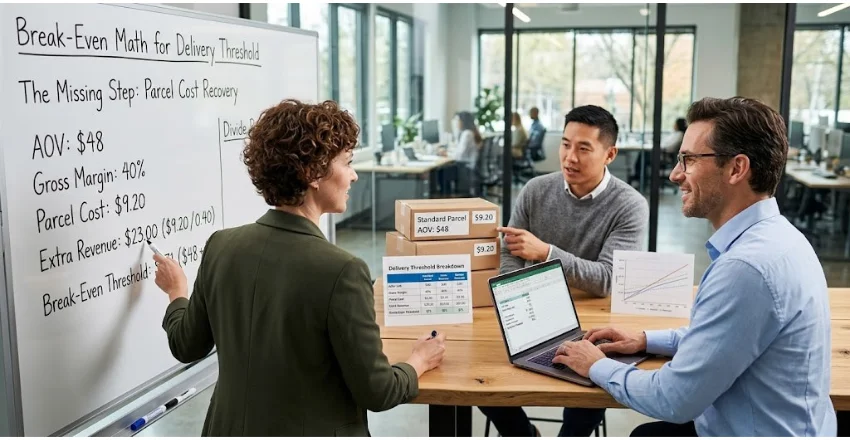
Here’s the part most guides skip. Absorbing a parcel cost doesn’t mean you need to recover the parcel cost. You need to recover it out of gross margin, and that takes more revenue than the cost itself.
Getting there takes one division. Take your all-in parcel cost, divide it by your gross margin rate, and you get the extra revenue every order has to produce.
Here’s a worked example. Say your average order value is $48, your gross margin is 40%, and a typical parcel costs $9.20 door-to-door. Divide $9.20 by 0.40, and you get $23. Your average order has to reach $71 before the offer pays for itself, which is a threshold number you can defend to anyone who asks.
That’s why a sensible minimum sits above your current average rather than on it. Set it at $50 when you already average $48, and you’re handing delivery away on orders you were getting anyway.
Break-even thresholds at three sets of numbers
| Average order value | Gross margin | Parcel cost | Extra revenue needed | Break-even threshold |
|---|---|---|---|---|
| $32 | 25% | $8.00 | $32 | $64 |
| $48 | 40% | $9.20 | $23 | $71 |
| $85 | 55% | $11.00 | $20 | $105 |
What the absorbed cost actually covers
Postage is only part of it. Absorbed cost also covers packaging, handling time at the bench, and the carrier surcharges that land on residential addresses, remote zip codes, and oversized boxes. Those surcharges are where quoted rates and real invoices part company. Packaging alone runs bigger than most sellers budget for, and our guide to what custom packaging costs breaks the components apart.
Then there’s the return. A returned parcel pays freight twice, once outbound and once home, and the hidden cost of a generous returns policy usually dwarfs the outbound rate on its own. Apparel sellers feel this hardest, since a chunk of every order comes back by design.
Rates keep moving with fuel, capacity and driver supply, so a number that worked last year may not hold this one. Our piece on technology in the trucking industry covers what’s changing behind the scenes. Re-price your threshold once a year, and again whenever your carrier contract renews.
Should your store offer free shipping?
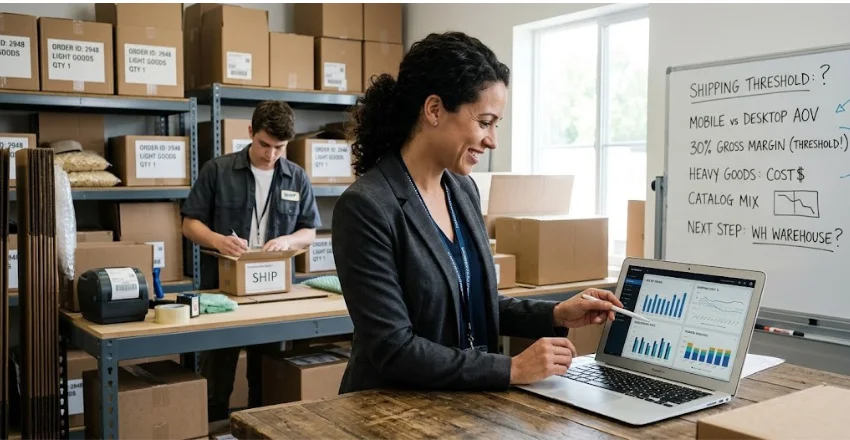
For most US retailers, yes, but behind a threshold rather than across the board. The blanket version works when margins are fat, parcels are light, and buyers come back often. Think twice in these cases.
- Heavy or bulky goods, where the parcel rate rivals the product margin.
- Gross margins under roughly 30%, where the break-even revenue climbs fast.
- Catalogs built around one dominant item, since buyers have nothing natural to add.
- Mobile-heavy traffic, for the reason below.
That last one catches people out. Mobile shoppers spend less per order than desktop shoppers, so a threshold set from a blended average order value fails the mobile half of your traffic with their smaller carts. Segment the figure by device first. You may end up running two offers, or accepting that phone buyers pay the fee. Holding inventory closer to your customers helps as well, and planning a warehouse expansion is the usual next step once volume justifies it.
Your next move
Buying? Note the threshold before you fill the cart, not after. Selling? Open a spreadsheet, divide your all-in parcel cost by your gross margin rate, and hold that answer up against your current average order value. If the gap looks uncomfortable, your minimum is too low. Fix it this week, then watch what happens to average cart size over the next month.
Frequently asked questions
No. Free shipping is a pricing decision, and the money comes out of the product price, the minimum order value, or the seller’s margin. You’re paying either way, just not on a separate line.
Most stores land somewhere between $35 and $75. Book and beauty retailers cluster low, furniture and outdoor gear sit high, and specialty brands often set theirs at roughly 1.3 times their average order value.
Yes, whenever the filler costs more than the charge, and you don’t want it. Paying $7 beats spending $18 on something that sits in a drawer. Reverse that when the add-on is a consumable you’d reorder anyway.
A threshold usually earns more per order, because it moves cart size. Flat rate is simpler and reads as honest, and it suits stores with wildly variable parcel weights. Test both on your own numbers.
It reduces the abandonment caused by fee shock at the last step, which is a real slice of lost carts. It won’t rescue a slow site, a thin returns policy, or a price that was never competitive.

