
The Mustang RTR Spec 3 turns a current Mustang GT into an 810-horsepower, supercharged street car with adjustable suspension. RTR also adds distinctive body hardware, staggered 20-inch wheels, Nitto tires, graphics, and signature lighting. For U.S. buyers, the package starts at $33,995 above the price of the donor Mustang GT. That headline power figure makes the car sound like an automatic performance bargain. Real-world testing shows a more complicated story because rear-tire traction can limit hard launches. The result is a Mustang built as much around character and customization as outright stopwatch numbers.
Direct answer: The RTR Spec 3 combines a Mustang GT with a Ford Performance 3.0-liter Whipple supercharger producing 810 hp and 615 lb-ft. Its $33,995 starting package also adds adjustable suspension, 20-inch staggered wheels, Nitto tires, RTR aero pieces, lighting, graphics, badging, and a three-year/36,000-mile warranty.
Mustang RTR Spec 3 at a Glance
| Item | U.S. specification |
|---|---|
| Base vehicle | 2026 Ford Mustang GT |
| Engine | 5.0-liter V8 with 3.0-liter Whipple supercharger |
| Claimed output | 810 hp |
| Claimed torque | 615 lb-ft |
| Drive layout | Rear-wheel drive |
| Transmission | Manual or automatic configuration available |
| Front wheels | 20 x 9.5 inches |
| Rear wheels | 20 x 10.5 inches |
| Front tires | Nitto NT555 G2, 275/35R20 |
| Rear tires | Nitto NT555 G2, 295/35R20 |
| Package starting price | $33,995 above the Mustang GT |
| Warranty | 3 years/36,000 miles |
| Recommended fuel | 91+ octane for full advertised performance |
RTR lists the 2026 package at $33,995abovethebasevehicle,withpartsandlaborincluded.Taxes,title,registration,dealerfees,andadditionaloptionscanraisethefinalprice.TheMustangGTitselfstartsaroundtheupper-$40,000 range for the 2026 model year.
Key Takeaways
* RTR claims 810 hp and 615 lb-ft from the supercharged 5.0-liter V8. * The package starts at $33,995 above the cost of the donor Mustang GT. * Adjustable suspension hardware is standard rather than an appearance-only addition. * Staggered 20-inch RTR wheels wear Nitto NT555 G2 performance tires. * Independent tests show that traction can limit standing-start acceleration. * Buyers pay for exclusivity, styling, adjustability, and warranty-backed integration. * A Dark Horse may suit drivers focused mainly on braking, grip, and track consistency.
Mustang RTR Spec 3 Specs and Hardware Explained
The centerpiece is Ford Performance’s 3.0-liter Whipple supercharger fitted to the GT’s 5.0-liter V8. RTR rates the combination at 810 horsepower and 615 pound-feet of torque. Cars without active exhaust can produce 10 fewer horsepower according to RTR’s current specification notes. That output represents a major jump over a standard 2026 Mustang GT. Ford currently rates the GT’s naturally aspirated 5.0-liter engine at 480 horsepower.
The difference gives the RTR car much stronger acceleration once the rear tires can use the available power. The suspension receives more attention than a typical dealer-installed supercharger package. RTR fits adjustable front struts, rear shocks, lowering springs, and adjustable front and rear sway bars. Drivers can therefore alter chassis behavior instead of accepting one fixed suspension calibration.
What Else Comes With the Spec 3 Package?
The exterior package changes nearly every major visual area without turning the car into a full widebody. It includes revised upper, lower, and corner grilles, plus a chin splitter and undertray extension. Rocker splitters, rear-quarter splitters, a hood vent, and a decklid spoiler complete the main body changes. RTR’s upper grille also includes its recognizable LED air-intake lighting. Buyers receive RTR badging, a graphics package, windshield banner, floor mats, and a branded shift knob.
A serialized dash plaque and certificate of authenticity help identify the finished vehicle as a genuine build. Wheel and tire sizing also differs from a standard GT configuration. RTR specifies 20-by-9.5-inch front wheels and 20-by-10.5-inch rear wheels. Nitto NT555 G2 tires measure 275 millimeters wide in front and 295 millimeters at the rear.
How Fast Is It in Real-World Testing?
An 810-horsepower rating does not guarantee supercar-level standing-start times on street-oriented rear tires. Car and Driver recorded 0-60 mph in 4.7 seconds with its manual test car. That same vehicle completed the quarter-mile in 12.7 seconds during the publication’s testing. MotorTrend produced somewhat stronger numbers from another test vehicle.
Its car reached 60 mph in 4.5 seconds and completed the quarter-mile in 12.3 seconds. The trap speed reached 124.3 mph, showing substantial power once traction became less limiting. These results explain the car’s unusual performance personality. The available horsepower is enormous, but launching requires careful throttle management. Rolling acceleration and power-on driving better display what the supercharged engine can deliver.
Spec 3 vs. Mustang GT vs. Dark Horse
| Category | RTR Spec 3 | Mustang GT | Mustang Dark Horse |
|---|---|---|---|
| Engine | Supercharged 5.0L V8 | Naturally aspirated 5.0L V8 | Modified naturally aspirated 5.0L V8 |
| Output | 810 hp | 480 hp | 500 hp |
| Main focus | Power, style, adjustability | Everyday V8 performance | Track-focused factory performance |
| Suspension | RTR adjustable setup | Standard GT setup | Factory performance chassis |
| Package positioning | Aftermarket-enhanced GT | Core V8 Mustang | Ford performance trim |
| Best fit | Buyers wanting drama and customization | Traditional Mustang buyers | Drivers prioritizing track balance |
The GT remains the simpler choice for buyers wanting V8 performance without a major conversion cost. Ford lists the 2026 GT Fastback at a starting MSRP of $47,800 on its primary model page. Adding the base RTR package price places a basic Spec 3 build above $80,000 before extra options and fees. The Dark Horse approaches performance differently. Ford gives it 500 horsepower, MagneRide damping, Brembo brakes, and other factory track hardware. Its lower output matters less for buyers who prioritize predictable braking, cornering, and repeated track use.
What Does a Mustang RTR Spec 3 Really Cost?
RTR’s current advertised package starts at $33,995 above the Mustang GT base vehicle. That amount covers the listed Spec 3 parts and labor, but it does not include the donor car. Taxes, registration, dealer charges, paint choices, exhaust options, and interior upgrades can raise the total. A simple base-price calculation puts the entry point near $81,795 using Ford’s $47,800 GT figure.
That is only an approximate starting point because vehicle pricing and dealer inventory can vary. Heavily optioned examples tested by major publications have exceeded $100,000. MotorTrend’s tested example carried a $107,215 as-tested price. Car and Driver tested another heavily optioned example costing $109,808. Those prices put loaded builds into territory occupied by much more specialized performance cars.
Pros and Cons
Pros
* 810-horsepower supercharged V8 delivers huge rolling acceleration. * Adjustable suspension offers meaningful chassis tuning. * Styling is more distinctive than a standard Mustang GT. * Staggered wheels and tires come standard. * Warranty coverage adds reassurance to the modified package. * Serialized hardware gives the car additional identity.
Cons
* Rear-tire traction can limit standing-start acceleration. * The $33,995 package does not include the donor Mustang. * Loaded examples can cross the $100,000 mark. * Standard brakes are not upgraded as dramatically as the engine. * Buyers focused on lap times may prefer a Dark Horse configuration. * Performance depends heavily on tires, surface conditions, and driver technique.
Who Should Buy One?
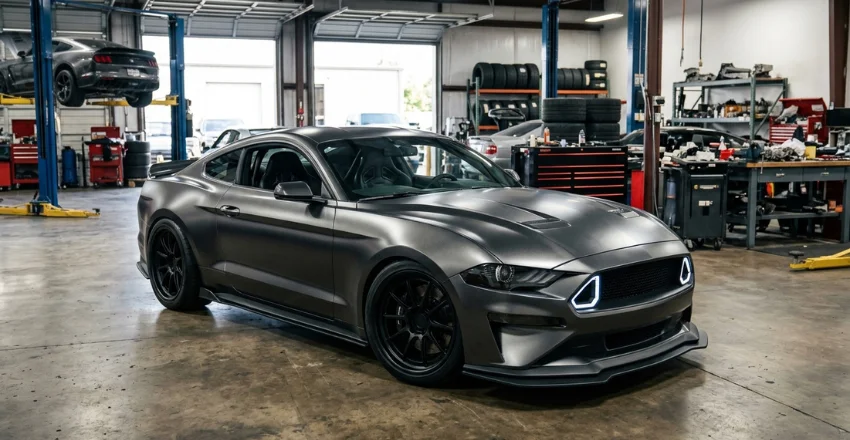
This car makes the most sense for someone who wants a Mustang with major power and a strong visual identity. The buyer should value customization and street presence alongside outright acceleration. Adjustable suspension also appeals to owners willing to experiment with chassis settings.
Motorsport fans who enjoy reading about drivers such as Kyle Busch and his NASCAR career will understand the appeal of a street car tuned for speed. It makes less sense for someone shopping only by quarter-mile time or road-course results. An 810-horsepower rear-drive car needs enough tire and road surface to use its engine effectively. Independent testing shows that more power doesn’t always mean a quicker launch.
Our Verdict
The Spec 3 succeeds as a high-character Mustang rather than a pure numbers exercise. Its strongest qualities are the supercharged V8, adjustable chassis, aggressive design, and rarity. Those features appeal to enthusiasts who want something more distinctive than a stock GT. Buyers should still judge the full price rather than the horsepower figure alone.
Once options move the car beyond $100,000, alternatives become much harder to ignore. A careful buyer should compare a realistic dealer quote against a Dark Horse before signing paperwork. For U.S. street use, the package offers a combination Ford doesn’t provide in a regular GT. You get huge power with recognizable RTR styling and documented package hardware. The tradeoff is paying a significant premium for performance that demands respect and careful throttle control.
Frequently Asked Questions
How much horsepower does the Mustang RTR Spec 3 have?
RTR rates it at 810 horsepower and 615 pound-feet of torque with the current 3.0-liter Whipple setup. That rating applies to the advertised configuration using the required fuel and equipment. RTR notes that certain non-active-exhaust cars can produce 10 fewer horsepower.
How much does the package cost?
The 2026 package starts at $33,995 above the price of the base Mustang GT. RTR says that figure covers parts and labor but excludes the underlying vehicle. Taxes, title, registration, dealer charges, and additional options are also separate.
Is the Spec 3 faster than a normal Mustang GT?
It has far more engine output, especially during rolling acceleration. Standing-start results depend heavily on traction and launch technique. Car and Driver’s manual test showed that its example did not beat a stock GT to 60 mph.
Does it have upgraded suspension?
Yes, and the suspension changes are a major part of the package. RTR installs adjustable struts, shocks, sway bars, and lowering springs. That hardware allows more tuning than the standard GT suspension provides.
Does the price include a new Mustang?
No, the advertised package price sits above the cost of a donor Mustang GT. RTR specifically states that the base vehicle is not included. Buyers should request an itemized total before comparing the car with factory performance models.
Is it worth buying?
It can be worth buying if you value 810 horsepower, RTR styling, adjustable suspension, and exclusivity together. A Dark Horse deserves comparison if track balance matters more than maximum engine output. The final choice should depend on the complete out-the-door price rather than horsepower alone. —

