
NY state unemployment provides temporary weekly payments to eligible workers who lose their jobs through no fault of their own and remain ready, willing, and able to work and actively seek work. For 2026 claims, the maximum weekly benefit is $869; regular benefits can total up to 26 times your weekly rate, and you should file during your first week out of work.
| 2026 New York UI fact | What to know |
|---|---|
| Maximum weekly benefit | $869 |
| Minimum weekly benefit | $140 |
| 2026 wage threshold | At least $3,500 in one base-period quarter |
| Other wage requirement | Wages in at least two calendar quarters, plus the required total base-period wages |
| Regular benefit limit | Up to 26 times your full weekly benefit rate |
| Work search | At least three qualifying activities each week, unless exempt |
| Part-time work | Partial benefits may be possible at 30 hours or fewer and within the earnings limit |
| Best time to file | During your first week of total or partial joblessness |
The $869 maximum took effect in October 2025, while the minimum rose to $140 for 2026. New York also increased the one-quarter earnings requirement to $3,500 for claims filed in 2026.
Key Takeaways
- File as soon as you enter your first week without full-time work.
- You need enough covered wages and must meet continuing eligibility rules.
- The current weekly range for qualifying claimants is $140 to $869.
- Most people must complete and record at least three work-search activities each week.
- Part-time earnings do not always end a claim, but hours and gross pay affect payment.
- Weekly certification is required while you remain eligible and want to receive benefits.
- A denial can be challenged by requesting a hearing, generally within 30 days.
How NY State Unemployment Works in 2026
New York’s UI program replaces part of a worker’s lost wages for a limited period. The New York State Department of Labor (NYS DOL) determines whether a claimant qualifies. You generally need enough covered employment, an eligible reason for becoming jobless, and continued availability for work. You must also actively seek suitable work unless the department gives you an exemption.
For NY unemployment eligibility on a claim filed in 2026, the earnings test has three main parts. You must have wages in at least two calendar quarters of your base period. One quarter must contain at least $3,500 in wages. Your total base-period wages must also equal at least 1.5 times your high-quarter wages. NYS DOL uses no more than $19,118 of high-quarter earnings when applying that test.
Losing a job due to layoff, downsizing, seasonal work ending, restructuring, or lack of work may support eligibility. Quitting without a qualifying cause or being discharged for misconduct can result in denial. The department, not your employer, makes the final eligibility decision.
How Much Can You Receive Each Week?
For 2026, New York’s maximum weekly UI rate is $869. The minimum rate is $140 for qualifying claims. The standard calculation usually starts with your highest-paid calendar quarter during the applicable base period. In many cases, NYS DOL divides high-quarter wages by 26. When high-quarter wages are $3,575 or less, it generally divides them by 25 instead.
For example, suppose qualifying high-quarter wages were $13,000. Dividing $13,000 by 26 gives an estimated weekly rate of $500. The state makes the official calculation after reviewing your wage record. Your Monetary Determination shows the weekly amount calculated from reported wages. It does not, by itself, guarantee payment because non-monetary eligibility issues can still affect the claim.
One easy mistake is relying on an older guide that lists $504 as New York’s maximum. That figure is outdated. The state increased the maximum to $869 effective October 6, 2025.
How Long Can You Receive Benefits?
Eligible New Yorkers can receive regular benefits totaling up to 26 times their full weekly rate during the benefit year. A benefit year lasts one year from the claim’s effective date. That does not always mean 26 consecutive full-payment weeks. Part-time work, weeks of ineligibility, and other claim changes can affect when payments are made.
For a household adjusting to reduced income, GetGoodRead’s Finance section offers broader reading on budgeting and financial decisions. State benefit rules should still be verified through NYS DOL.
How to File a Claim and Keep It Active
Filing the initial claim is only the first part of the process. You also have to certify for eligible weeks afterward.
- File during your first week out of full-time work. Waiting may cause you to lose payable weeks.
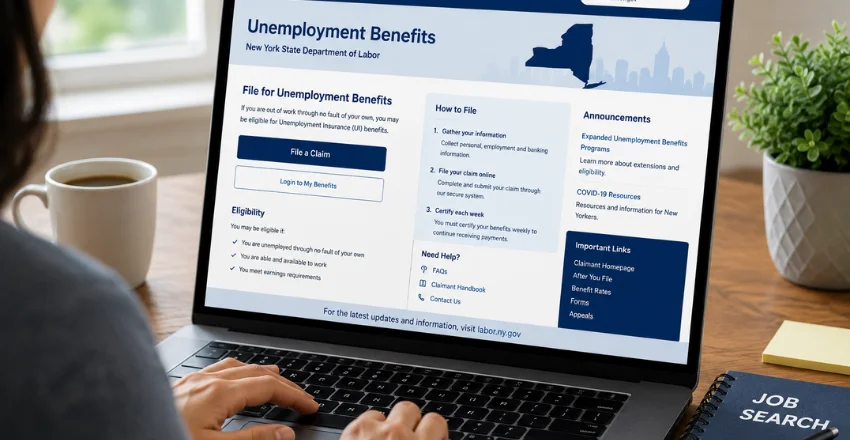
- Use NYS DOL’s online claim system. The department identifies online filing as its preferred method for a new claim.
- Provide accurate work and wage information. Follow the application prompts carefully and accurately identify your recent employment.
- Review your Monetary Determination. Check the employer’s wages and calculated weekly rate for errors.
- Complete your weekly certification. Continue certifying for each week you meet the rules and want payment.
If online filing is not workable, NYS DOL’s Telephone Claims Center can be reached at 888-209-8124. Claimants should use official state contact information rather than numbers supplied through unsolicited calls or messages.
The New York State Department of Labor’s unemployment filing FAQs state that the first payment is generally made within 2 to 3 weeks after a completed claim is processed. A claim review can extend that period when the department needs more information. Respond quickly if NYS DOL requests documents or answers. Missing a request can delay a decision and may contribute to a denial.
Can You Work Part-Time and Still Get Benefits?
Yes, in some cases. New York uses an hours-based partial-benefit system. A claimant may remain eligible while working 30 hours or fewer in a week and earning within the state’s current earnings limit. The 2026 partial-benefit guidance uses $869 as that weekly gross-pay threshold. Your payment can decrease as your weekly work hours increase.
Report every hour and all required earnings accurately when you certify. Part-time work can also be useful during a job transition because it preserves current experience and income. Readers exploring changing employment patterns can browse GetGoodRead’s Business section for related workplace topics.
Work Search Rules You Must Follow
Most claimants must actively look for work. New York requires at least three qualifying work-search activities each week, unless an approved exemption or work-search plan changes the requirement. Qualifying activities may include submitting applications, attending interviews, using Career Center services, attending a job fair, taking an employment test, or contacting placement services.
Keep an accurate record. NYS DOL can request the record and verify the listed activities. False information can lead to repayment obligations, penalties, or other enforcement. Your search does not have to stay inside the exact role you recently lost. Industries change, and openings may require new skills. GetGoodRead’s article on technology and trucking-industry jobs is one example of how changing technology can reshape job requirements.
Are Your Weekly Payments Taxable?
Yes. Benefits paid through the program are taxable income and are reported on Form 1099-G. New York lets claimants elect withholding from weekly payments. The current options are 10% for federal income tax and 2.5% for New York State income tax. You can change withholding choices through your account.
Choosing withholding can reduce the amount deposited each week, but it may also reduce the tax balance due later. Your personal tax result depends on your total income and filing situation.
What Happens If Your Claim Is Denied?
A denial is not necessarily the end of the process. NYS DOL sends a determination explaining why it found you ineligible. If you disagree, you may request a hearing within 30 days from the date of the determination. Read the notice as soon as you receive it. Identify the issue, gather supporting records, and follow the hearing instructions carefully.
Evidence can vary by dispute. It may include wage records, schedules, messages with an employer, termination documents, medical records when relevant, or other material tied to the reason for separation. Keep certifying for eligible weeks while a dispute is pending if NYS DOL instructs you to do so. Winning an appeal does not help with weeks that were never properly claimed.
Your Next Step
If you recently lost work in New York, start with the official NYS Department of Labor filing information. File promptly, read every notice, and keep copies of your wage, claim, certification, and work-search records. This GetGoodRead guide was researched against current NYS DOL information available on August 28, 2026.
Rules and benefit amounts can change, so verify claim-specific questions with the department. This article provides general information and is not legal, tax, or financial advice.
Frequently Asked Questions
The maximum weekly benefit is $869, while the minimum is $140 for qualifying 2026 claims. Your personal weekly rate depends mainly on wages in your applicable base period.
Yes. NYS DOL says workers should file even when a former employer says they are not eligible. The state reviews the facts and makes its own decision.
Possibly. The current partial-benefit rules may allow payment when you work 30 hours or fewer and stay within the applicable weekly earnings limit. Report your hours and earnings when certifying.
Usually, yes. Most claimants need at least three documented work-search activities each week unless NYS DOL has approved an exception or different plan.
File during your first week of total or partial joblessness. NYS DOL warns that waiting can cost you benefits for weeks if claims are not properly filed.
Yes. Benefits are taxable income. New York provides a 1099-G and allows voluntary federal and state tax withholding from weekly payments.

