
A search warrant gives law enforcement legal authority to search a specified place, person, property, or certain information for evidence connected to a criminal investigation. In the United States, the Fourth Amendment generally protects people against unreasonable government searches. It requires that warrants be supported by probable cause and describe with particularity what may be searched or seized. The details matter because a warrant does not ordinarily give police unlimited authority to search anything they encounter.
Quick answer: A search warrant is a court-authorized order allowing law enforcement to search a specifically identified place, person, property, or information for evidence. Under the Fourth Amendment, a valid warrant generally requires probable cause, sworn support, judicial approval, and a particular description of the place to be searched and the items or people to be seized.
Searches involving a home, vehicle, phone, computer, online account, or location data can raise different legal questions, and federal and state procedures are not always identical. Federal Rule of Criminal Procedure 41 sets forth important rules governing federal warrants, while states use their own constitutions, statutes, court rules, and judicial decisions. This guide therefore explains the main U.S. principles rather than giving case-specific legal advice.
Key Takeaways
- The Fourth Amendment prohibits unreasonable searches and seizures and requires probable cause for warrants.
- A warrant should clearly identify the place, person, property, or information that law enforcement is authorized to search for or seize.
- Police generally cannot treat a warrant as unlimited permission to search every location or person they encounter.
- Federal Rule 41 ordinarily requires a federal warrant to be executed within no more than 14 days.
- Some searches can legally occur without a warrant when a recognized Fourth Amendment exception applies.
- Police generally need a warrant before searching the digital contents of a cell phone seized during an arrest, subject to case-specific exceptions.
- In June 2026, the U.S. Supreme Court held that government acquisition of certain geofence location data constitutes a Fourth Amendment search.
- Federal and state law can differ, so the actual warrant, jurisdiction, and circumstances of the search remain important.
What Is a Search Warrant?
A search warrant is an order issued by a judge or magistrate that authorizes law enforcement to conduct a particular search for evidence or other items the law permits officers to seize. It is designed to place a neutral judicial decision-maker between investigators and an intrusion into areas protected by the Fourth Amendment. A warrant therefore serves both an investigative function for law enforcement and a constitutional limiting function for the person or property being searched.
The warrant itself is only part of the process because investigators generally must first present information establishing probable cause. The judge evaluates the information rather than automatically approving a police request. If the required legal standard is met, the judge can issue a warrant that defines the permitted scope of the search.
What Does the Fourth Amendment Require for a Search Warrant?
The Fourth Amendment provides that warrants cannot be issued without probable cause supported by an oath or affirmation, and requires particularity in describing the place to be searched and the persons or things to be seized. Those requirements are intended to prevent broad, exploratory searches in which officers receive unrestricted discretion to look for anything they might find. Courts have developed a substantial body of law explaining how probable cause and particularity apply in real investigations.
| Requirement | What it generally means |
|---|---|
| Probable cause | Facts must support a reasonable basis for believing evidence, contraband, a person, or another proper object of the warrant will be found. |
| Oath or affirmation | The supporting information is presented under a legally recognized sworn process |
| Neutral judicial approval | A judge or magistrate evaluates whether the legal requirements have been satisfied. ied |
| Particularity | The warrant identifies what or where may be searched and what may be seized |
| Proper execution | Officers must execute the warrant consistently with applicable constitutional, statutory, and procedural rules. |
Probable Cause
Probable cause does not require investigators to prove the entire criminal case before a warrant can issue. Instead, the judge considers whether the information presented provides a legally sufficient basis to believe that the proposed search will uncover evidence or another proper object of the search. The Constitution Annotated notes that probable cause is a judicially developed concept and that the warrant applicant must present sufficient facts for the magistrate to make that determination.
Particularity
Particularity limits the scope of a warrant by requiring an adequate description of what police are authorized to search and seize. The Supreme Court has explained that this protection is intended to prevent general searches and reduce the discretion left to officers carrying out the warrant. A warrant for one apartment, device, account, or category of evidence does not automatically authorize every imaginable search associated with the investigation.
How Do Police Get a Search Warrant?
Investigators generally prepare an affidavit or otherwise provide sworn information explaining the facts supporting probable cause and what they want authority to search or seize. A judge or magistrate reviews that material and determines whether the constitutional and procedural requirements are satisfied. Federal Rule 41 also permits a magistrate judge to issue a warrant based on information communicated by telephone or other reliable electronic means when the applicable procedures are followed.
In a federal case, a warrant may cover evidence of a crime, contraband or illegally possessed items, property designed or used for committing a crime, or a person who is to be arrested or is unlawfully restrained. Rule 41 also contains specialized provisions involving tracking devices and electronically stored information. State warrant procedures can address similar issues, but the exact terminology and requirements vary by jurisdiction.
What Can Police Search With a Warrant?
The answer begins with the language of the warrant rather than with a general assumption about police power. Officers may ordinarily search locations where the objects described in the warrant could reasonably be found. Still, the permitted area depends on what the warrant authorizes and the nature of the evidence being sought. A warrant for a large physical object, for example, would not logically authorize opening a container too small to hold it merely because the container happens to be inside the premises.
This principle becomes especially important in homes containing several rooms, detached structures, vehicles, digital devices, safes, bags, and other containers. The warrant and supporting legal authority determine whether those places fall within the scope of the authorized search. At the same time, the Fourth Amendment’s particularity requirement limits a general search through unrelated property. When a court examines a warrant, judges may examine both the warrant’s language and how officers actually searched.
What Can Police Seize During the Search?
Police executing a warrant may seize evidence and property that the warrant properly authorizes them to take. Under federal Rule 41, permissible objects can include evidence of a crime, contraband, illegally possessed property, instrumentalities of crime, and certain persons. Officers must also prepare an inventory of seized property under the federal execution rules.
An important complication is the plain-view doctrine, which can sometimes allow officers lawfully present during a search to seize incriminating evidence that was not specifically listed in the warrant. That does not mean officers may use “plain view” as a reason to search locations outside the authority granted to them. The doctrine operates within constitutional limits and can become highly fact-specific when its application is disputed.
How Long Is a Warrant Valid?
For a federal warrant governed by Rule 41, the warrant must direct officers to execute it within a specified period of no more than 14 days. The federal rule also states that execution is normally during daytime unless a judge expressly authorizes another time for good cause, and Rule 41 defines daytime as 6:00 a.m. to 10:00 p.m. local time. These are federal procedural rules, so readers should not assume every state uses the same deadline or time-of-day requirements.
Timing can matter because probable cause is based on facts existing when the warrant is sought, and information can become stale as circumstances change. A delay may therefore raise questions beyond simply checking the date printed on the warrant. Whether a particular delay affects validity depends on the governing law and facts of the investigation.
Do Police Have to Show You the Warrant?
In a federal search, Rule 41 requires the officer executing the warrant to give a copy of the warrant and a receipt for any property taken to the person whose property or premises were searched. If no one is present to receive them, the officer must leave the documents at the location where the property was taken. The rule does not mean that every dispute about when an occupant must physically see the paperwork has the same answer. State rules can impose different procedures, and delayed-notice warrants or particular types of electronic searches may involve additional provisions.
If officers are searching, reading the warrant can help identify the address, property, person, items, or information the court ordered them to search for or seize. A person can also preserve the paperwork for an attorney to review afterward. Attempting to block or interfere with officers physically is different from calmly asking for a copy or stating that you do not consent to any search beyond what the warrant legally authorizes.
Can the Police Search Everyone Present?
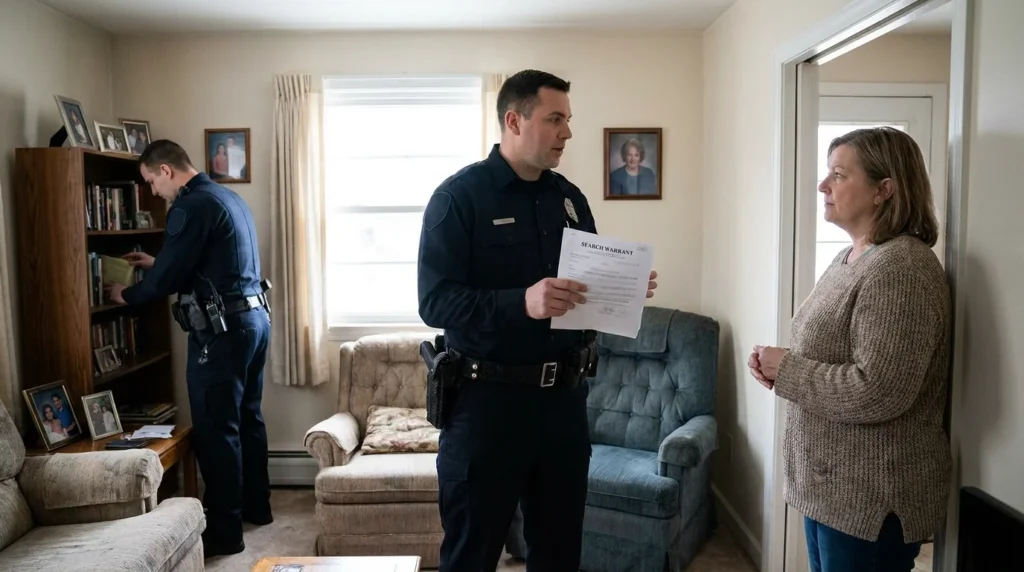
A premises warrant should not be understood as automatic permission to search every person who happens to be nearby. The legal basis for searching an individual may depend on whether the person is specifically described in the warrant or another recognized legal justification applies. Courts distinguish the authority to control or detain occupants during execution of some warrants from the separate question of whether police have legal authority to search a particular person’s body or belongings.
This distinction matters during searches of homes, businesses, hotel rooms, and other locations where several people may be present. The Supreme Court’s warrant cases have recognized law-enforcement interests in safely controlling the scene. At the same time, a search is conducted, but detention and personal searching are not necessarily the same Fourth Amendment act. Anyone facing a dispute over a personal search conducted during execution of a premises warrant should have the specific facts reviewed under the law of the relevant jurisdiction.
When Can Police Search Without a Warrant?
A warrant is an important Fourth Amendment protection, but one is not required for every lawful government search. Courts recognize specific exceptions, and whether one applies depends heavily on the circumstances rather than on a single universal rule. Exigent circumstances, for example, can sometimes make a warrantless search reasonable when officers face an emergency such as providing urgent aid, pursuing a fleeing suspect, or preventing imminent destruction of evidence.
Other warrant exceptions developed through Fourth Amendment case law include consent, certain automobile searches, searches incident to lawful arrests, and other narrowly defined situations. Each exception comes with its own requirements and limitations, so simply saying that an officer had “an exception” does not resolve whether the search was lawful. Courts examine what officers knew, what they did, and which legal doctrine actually applies.
Search Warrants for Cell Phones and Computers
Digital searches receive special attention because a modern phone can contain messages, photographs, browsing information, financial records, location history, medical information, contacts, and years of personal data. In Riley v. California, the Supreme Court held that police generally may not search digital information on a cell phone without a warrant merely because the phone was seized from someone during an arrest. The Court neveCourtess recognized that case-specific exigent circumstances can sometimes justify a warrantless digital search.
A digital warrant can also raise difficult questions about how investigators describe the data they are seeking and how broad a search of a device or account may be. Federal Rule 41 expressly addresses warrants for electronically stored information and permits later off-site review of seized or copied electronic information when authorized. The Fourth Amendment’s probable-cause and particularity requirements continue to matter even though searching digital information looks very different from searching a physical room.
What Changed for Geofence Warrants in 2026?
Geofence warrants seek location information about devices detected within a defined geographical area during a particular period, often before police have identified a specific suspect. On June 29, 2026, the U.S. Supreme Court decided Chatrie v. United States and held that the government’s acquisition of location-history information at its courthouse constituted a Fourth Amendment search. The Court vacated the lower-court judgment and remanded the case rather than resolving every question about whether the particular warrant satisfied the probable cause and particularity requirements.
The decision is important because traditional warrants often begin with a known target, whereas a geofence request may begin with a location and then identify device users. Chatrie confirms that obtaining the type of digital location data at issue in that case implicates Fourth Amendment protections, even when a technology company held the data. The ruling does not mean that every geofence warrant is automatically invalid; future disputes still require careful analysis of how the warrant was written and executed.
Search Warrant vs. Arrest Warrant
A search warrant authorizes a government search for specified evidence, property, information, or another legally proper object of the warrant. An arrest warrant, by contrast, authorizes law enforcement to take a particular person into custody in accordance with the governing criminal procedure. The two documents can appear in the same investigation, but one should not be treated as automatically conferring all powers associated with the other.
The distinction also explains why an arrest does not always permit unlimited searching of everything the arrested person owns. Riley, for example, rejected the idea that the traditional search-incident-to-arrest rule automatically authorizes police to examine all digital information stored on a seized phone. Readers interested in what court-ordered restrictions can look like later in a criminal case can also read GetGoodRead’s guide to house arrest and home confinement.
What If a Warrant Is Invalid or Police Exceed Its Scope?
A warrant can be challenged for reasons including inadequate probable cause, lack of particularity, problems with the information used to obtain it, or conduct that allegedly exceeded the scope of the search the judge authorized. A defendant in a criminal case may ask a court to suppress evidence when the governing law provides a basis for doing so. Federal Rule 41 specifically recognizes motions to suppress under the applicable criminal procedure, although constitutional doctrines and exceptions can complicate the outcome beyond a simple identification of a technical error.
Not every defect automatically causes evidence to disappear from a criminal case. Courts may consider doctrines concerning good-faith reliance, causation, standing, harmless error, and other issues depending on the circumstances. For that reason, assessing a potentially unlawful search usually requires the warrant, the affidavit, when available, the inventory, the police reports, the timeline, and other case-specific records.
What Should You Do If Police Arrive With a Warrant?
The safest practical approach is to avoid physically interfering with officers while preserving the ability to challenge the search through lawful procedures later. Ask to see or receive the warrant when appropriate, identify what location and property it describes, and keep any copy and inventory officers provide. You can also clearly state that you do not consent to searches beyond the legal authority officers claim, without attempting to obstruct execution of the warrant.
Avoid guessing about the law or trying to resolve a complex Fourth Amendment dispute at the doorway. Record relevant details afterward when lawful and safe to do so, including which agencies were present, what property was taken, and what documents were left behind. If the search is connected to a criminal investigation involving you, obtaining advice from a qualified criminal defense attorney in the relevant state is more reliable than relying on a general article on the internet.
Why the Exact Warrant Matters
Two searches that look similar on the surface can produce different legal outcomes because the warrant language, probable cause, jurisdiction, police conduct, and the object being searched may differ. A warrant for a house is not necessarily analyzed the same way as one involving a phone, a cloud account, a tracking device, or a geofence. The most useful starting point is therefore the actual document rather than a broad assumption that every warrant grants the same authority.
Federal law supplies a useful national framework through the Fourth Amendment and Rule 41, but states can add their own procedural requirements and sometimes provide protections under state constitutions. Local law is particularly important when questions involve nighttime service, notice procedures, warrant execution, or remedies after an allegedly unlawful search. Readers looking for other legal explainers on the site can browse GetGoodRead’s growing Law section, which also includes its 2026 guide to New York unemployment law and procedure.
The Bottom Line
A search warrant is not a blank check for law enforcement; it is judicial authorization bounded by the Fourth Amendment, the warrant’s terms, and the rules governing its execution. Probable cause and particularity remain central whether police are searching a house, seizing physical evidence, examining a phone, or requesting sensitive digital-location information. Because state law and individual circumstances can change the analysis, anyone dealing with an actual search should preserve the warrant and related paperwork and obtain legal advice specific to the jurisdiction.
Frequently Asked Questions
What is required for a search warrant?
In the United States, a warrant generally must satisfy the Fourth Amendment requirements of probable cause, an oath or affirmation, and particularity as to the place to be searched and the persons or things to be seized. A neutral judge or magistrate evaluates the application before issuing the warrant. Additional federal or state procedural requirements may apply depending on the jurisdiction and type of search.
How long do police have to execute a search warrant?
Under federal Rule 41, a warrant for a person or property must specify an execution period of no more than 14 days. Federal warrants normally direct daytime execution unless the judge authorizes another time for good cause. State warrant deadlines can differ, so the rule governing the specific warrant should be checked.
Can police search your phone with a warrant for your house?
Not automatically in every situation because the answer depends on the scope and language of the warrant and the legal basis authorizing a search of the device. Digital information receives substantial Fourth Amendment protection, and Riley v. California established that arrest alone generally does not authorize a warrantless search of phone data. When a phone search is disputed, courts examine the warrant, the information sought, and the circumstances of the seizure and search.
Can police take something that is not listed in the warrant?
Sometimes they can, including when the requirements of a recognized doctrine such as plain view are satisfied. That does not authorize officers to search beyond the lawful scope of the warrant merely to look for unrelated evidence. Whether a particular seizure was justified depends on where the officer was lawfully entitled to search and the facts surrounding the item discovered.
Can police search without a warrant in an emergency?
Yes, some emergencies can fall within the exigent-circumstances exception to the warrant requirement. Examples recognized in Fourth Amendment doctrine include emergency aid, hot pursuit, and circumstances involving imminent destruction of evidence. The existence of an emergency does not confer unlimited search authority, as courts still examine whether the warrantless action was objectively reasonable under the circumstances.
Do you have to consent if police already have a warrant?
A valid warrant does not ordinarily depend on the occupant voluntarily consenting to the search the warrant itself authorizes. Consent can matter, however, if officers ask to search additional places or property outside the authority they otherwise possess. A person can avoid physical interference while still stating that they do not consent to any search beyond the officers’ lawful authority.
Are geofence warrants legal in the United States?
The Supreme Court’s June 29, 2026 decision in Chatrie v. United States held that obtaining the location-history data involved a Fourth Amendment search. The Court did not declare every geofence warrant categorically lawful or unlawful and remanded for additional consideration. Probable cause, particularity, scope, and the exact data sought can therefore remain important in future geofence cases.

